Tag: Materials & Career

  • The Stories of Thermal Analyses of Materials

    The Stories of Thermal Analyses of Materials

    Every material has a relationship with heat. Yet, thermal behavior can rarely be something you can guess from a chemical formula, maybe possible for a top-notch theorist. But what is the point of guessing if we can heat the material up before our eyes? It turns out that hands-on is just the beginning.

    Under heat, some materials fall apart at the first sign of rising temperature, others hold steady until something deep inside gives out. It needs to be measured and understood in the context of a story. A story of why a product failed, why a process stalls, or why a brilliant formulation falls short when scaled.

    In this newsletter edition, I will decode the jargon in thermal analysis techniques. Future editions will delve deeper into the essence of each one.

    Let’s begin.

    From Theory to Reality

    In school, we learn thermal theory like it’s gospel. Question and answer are one-on-one. We talk about glass transition as a model zig-zag, melting point as a perfect peak, and decomposition as a single step. The curves are clean. The answers, exact. But in practice? Materials don’t behave like test questions. The data is messy. The peaks are broad and irregular. Sometimes what looks like noise is the actual clue you’ve been missing.

    The first roadblock we face when entering the world of thermal analysis is the jargon. Like many disciplines, jargon seems more formal and professional. But deep down, it is merely a symbol for a technique or a tool that helps us to add context to our story.

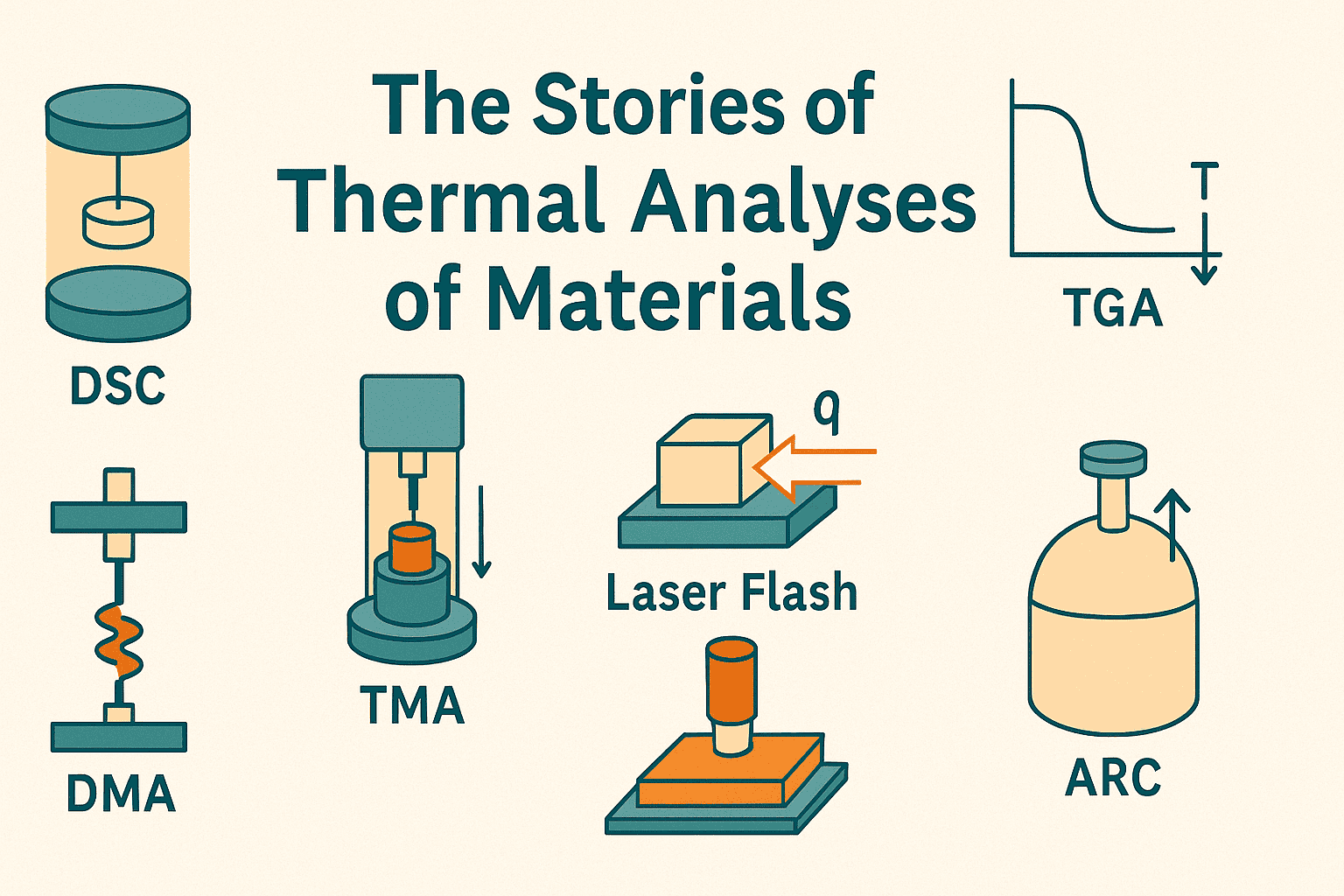
    I will start in this introductory newsletter by introducing six of the most common thermal analysis techniques. I am also using an imaginary story for each technique to help you get acquainted.

    DSC: Differential Scanning Calorimetry

    Let’s begin by heating a material and monitoring the energy input and output against temperature. Any physical or chemical change—like glass transition, melting, crystallization, and oxidation—in the material will bring about certain changes in the detected signal. This is DSC.

    A packaging company noticed that their food wrap film turns brittle during shipment in summer. The supplier claimed the polymer’s glass transition was 75 °C, well above shipping temperatures. DSC reveals an energy output peak well below 75 °C. It turns out that some batch of polymer was not fully cured. A simple DSC test avoided further loss and led to updated processing specs.

    TGA: Thermogravimetric Analysis

    From the name, we know it has something to do with heat and gravity. It is right. TGA measures weight changes of a material when we heat it up. Plain and simple. When things burn, decompose, or evaporate, TGA captures all of it. Sounds theoretical enough until the story follows.

    A product line of flame-retardant panels shows inconsistent performance in fire testing. TGA tells that weight loss profiles vary between units, some with weight loss at lower temperature. Tracing back to the raw material source, the vendor admits that a cheaper additive was used instead, which is the cause of early degradation. TGA analysis in this case forges hard requirements in raw material procurement.

    DMA: Dynamic Mechanical Analysis

    Dynamic means changing temperature. Mechanical, well, means mechanical. DMA takes a leap and measures how a material wiggles under a controlled force when heated. This behavior it monitors can tell how much and how well a material can store mechanical energy, or instead, dissipate it. Let me elaborate.

    Clients complain about excessive noise from the interior panels of an EV. Separate mechanical and thermal tests are all compliant. However, when you run a DMA test—which combines thermal and mechanical—it reveals that the polymer lacks sufficient damping at cabin temperatures which turns vibration into noise.

    TMA: Thermomechanical Analysis

    Want to know how and if a material expands or shrinks when heated? This is TMA. Even minute changes in dimensions are well captured, critical for delicate material parts that require durability and stability.

    Let’s run a failure analysis—why something fails—on a delamination issue of a flexible circuit board with TMA layer by layer. The results confirm a mismatch of thermal expansion between the adhesive layer and the substrate. No doubt when temperature increases, the building internal stress is enough to cause layer separation.

    LFA: Laser Flash Analysis

    The name tells nothing about what it does. Let me rephrase. LFA measures how efficient heat moves through a material. We normally refer to as thermal conductivity and thermal diffusivity. LFA is just the most popular way of measuring it.

    All EV batteries need thermal release during operation. We know that. Someone proposes to use a new lightweight composite for the enclosure. Using Laser Flash Analysis, we find that the new material has low thermal diffusivity, too low for rapid heat dissipation from the battery. A follow up formulation idea by adding 10% graphite filler doubled thermal conductivity and the new lightweight battery is in production.

    ARC: Accelerating Rate Calorimetry

    ARC monitors material self-heating at any temperature. An instrument is made so delicate that it gently heats up a material and then wait under the most extreme heat-isolated condition (an adiabatic process) to see if the temperature even increase one hundredth of a degree over time. This sounds like a tedious process. But in the field of ever more popular lithium ion battery, it often means life or death. Here is an example.

    A lithium ion battery supplier wanted to market their new electrolyte with a higher decomposition temperature. A just-in-case ARC test shows a self-heating onset at a temperature even lower than its predecessor. This might be bad news for the R&D team. But it surely saved lives by not having it hit the market.

    They work Hand in Hand

    Each technique tells a different aspect of the story. Much like a movie scene viewed from different angles and lenses. DSC reveals transitions. TGA shows stability. DMA tells you how a material feels under load. TMA monitors thermal distortion. LFA explains heat flow. ARC predicts danger. But used collectively, they do much more than test. They anticipate performance, explain failures, and guide the path to innovation.

    Some of these techniquesDMA and TMA in particular—overlap with mechanical and rheological analysis. Another topic we will be focusing on in the next newsletter edition. When we zoom out and take a God view of all the techniques, it is evident that all of them are interconnected. Our job is to use them to tell a compelling story.

    Looking Ahead with TEMPR Learning

    Instead of advocating for what the school should do, we will take the lead and just put down what we think is important. I am leveraging the TEMPR Learning platform to teach not just the theory for the sake of it, but the story of reasoning, purpose, and results. If you are in R&D, failure analysis, process engineering, or quality control, my mission is to give you both the technical and storytelling tools to succeed. For the new grads and soon-to-be, I am creating a helping bridge to replace your career dilemma.

    Thermal techniques are rarely taught as a whole in school. But they should be, and maybe even blending in the connections beyond the thermal scope. These techniques are seldom used alone in the field. They often work together to guide materials selection, qualify suppliers, solve customer complaints, and keep products safe.
  • What the TEMPR Learning

    What the TEMPR Learning

    We used to joke about why we chose materials science grad school over industry jobs. Doubling down, we even pursued postdoc studies, sometimes exceeding the duration of grad school. The joke? We said we cannot find jobs after college. Grad school and postdoc are ways we use to delay the reality that we have to face the real world. Deep down, we knew it was true.

    At the cusp of graduation with a PhD or five years postdoc on the CV, the reality sets in. We exhausted all options and now, we have to find a job. With a decade of academic education and dozens of peer-reviewed publications, we all think we are the perfect candidate for an independent researcher, until we are in the middle of a battle with the odds of 1/500. After the second failed attempt and some recollection, we have to convert the 10-page CV that used to make us proud into a one-page resume. Enters the grand unknown of industry. The textbook knowledge and lab skills become distant overnight. Years of experience post-graduation do not add up. The delayed reality is cruel.


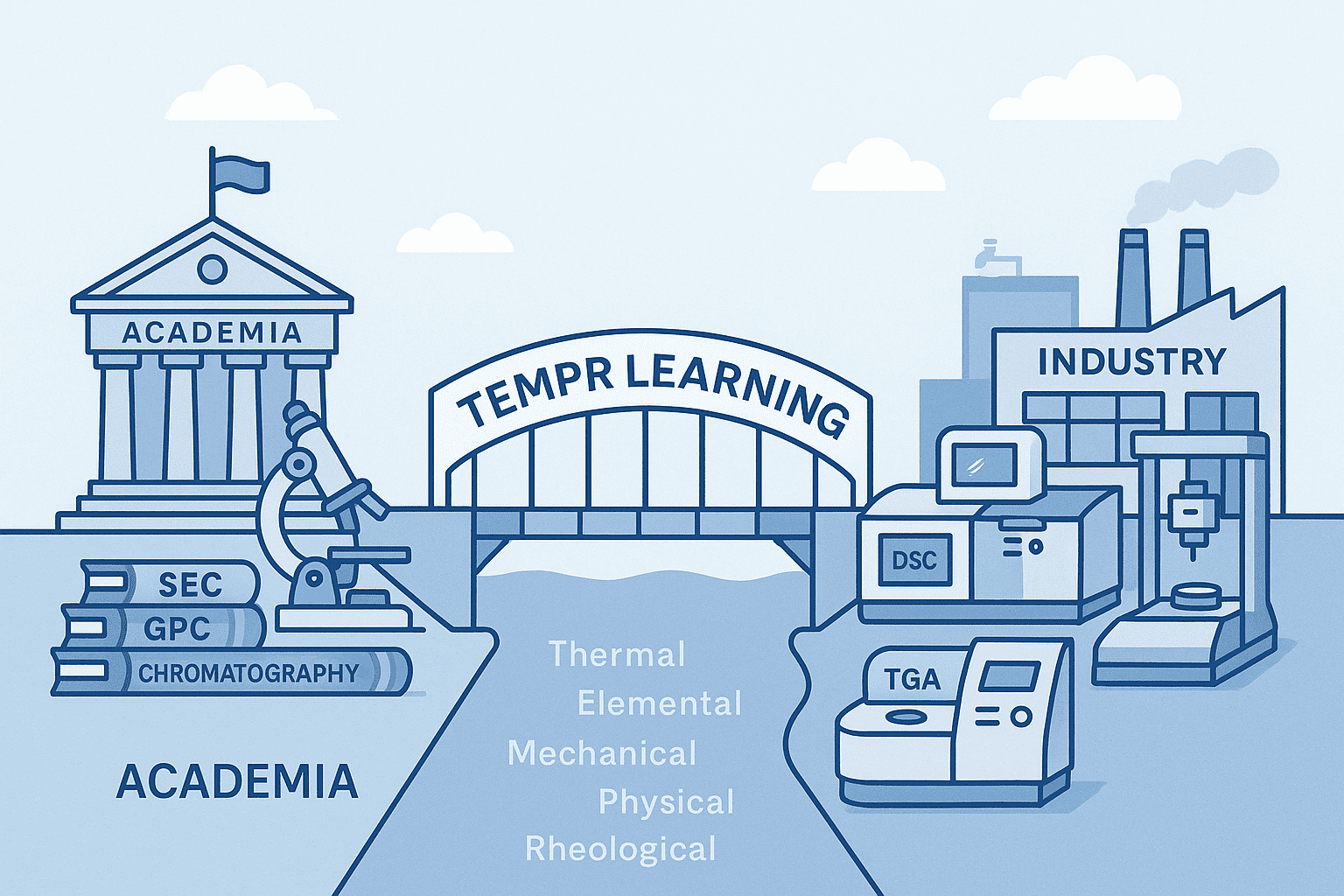
    The Gap Between Academia and Industry

    Many publications noted this gap between academia and industry (see References). Universities often focus on fundamental principles—thermodynamics, crystallography, phase diagrams—at the expense of hands-on training with real equipment. Teachers often provide ideal scenarios instead of realistic conditions. The results? These academic problems always have the right answers—perfect for testing and grading—while industry problems often don’t. To make it worse, interdisciplinary problems are entwined in most practical settings.

    Academic institutions are structured to prioritize research output and theoretical knowledge, not necessarily job readiness. Most faculty have limited industry experience and may not prioritize employability training for the same reason as the story at the beginning of this article—although they are the lucky ones in this context.

    Materials characterization techniques, in particular, are often taught in isolated courses (e.g., thermal or mechanical properties). Students may not understand how data from thermal analysis relates to the mechanical performance of a product. Beyond textbooks, classes rarely teach communication, project planning, or interpreting data for non-technical audiences—key skills in almost all careers.

    For new grads and fresh postdocs facing the industrial world, this leads to the struggle to adapt to hands-on roles involving material testing, quality control, failure analysis, or process optimization, the need to learn everything from scratch once hired, and the risk of underperformance or slow career growth due to low confidence in technical tools. Industry, on the other hand, suffers from increased onboarding time and training costs, risk of avoidable errors or poor decisions based on misinterpreted data, and bottlenecks in R&D and quality workflows.


    Bridging the Gap

    I have long been in the materials science field and experienced the pain of this gap firsthand and in a hard way. Ups and downs in this journey bring many stories to tell, although they have been buried for most of the previous years. At the 6th anniversary of leading TEMPR Lab, I finally decided to wait no more. Here it goes, TERMP Learning.

    TEMPR stands for Thermal, Elemental, Mechanical, Physical, and Rheological materials characterization techniques. TEMPR Learning is a collaborative initiative designed to bridge the gap between academic education and industry application, helping the next generation of materials scientists and engineers turn foundational knowledge into practical skills that matter at work.

    Leveraging the instrumentation in TEMPR Lab, my learning and understanding of relevant techniques, and the technical know-how from experts in various industrial fields, TEMPR Learning will create accessible content grounded in real industry workflows, highligh how thermal, elemental, mechanical, physical, and rheological tools are used in the real world, and equip the next generation materials scientist with industry ready skills, not just technical but also the best way to tell a story.

    What We Try to Solve

    Academic programs focus almost solely on equations and concepts, leaving out more important practical skills that solve real-world problems. A typical mindset expected from a new graduate researcher would be to: find something new -> make it happen -> find where it is useful -> publish it. In contrast, what the real world expects is to: identify a problem -> think of a solution -> leverage the techniques needed -> make the world a better place.

    The contrast is self-evident. Just to list some of the day-to-day skills that we hope that we learned from school: how to select the right technique under time constraints, how to interpret noisy data and to communicate findings to cross-functional teams, and how to link measurements to product decisions. The disconnect induced by a stereotypical academic thinking slows down careers and innovation.

    How We Do It

    We identified the problem. Here is a solution. We change the ways we teach, the subjects we teach, the style we interact with students, and the expectations for the graduates. Sounds appealing but vague. What about the action items and techniques needed?

    For resources, we will employ practical contexts, use-case problem solving, and career-building. We want to build a platform for new grads and early-career scientists and engineers. We’d love to see them choose and apply testing methods with confidence, present compelling stories with eloquence, communicate practical data with persuasion, and build professional reputations with assertiveness.

    For techniques, TEMPR Learning will provide real-world examples, product development workflows, and practical techniques that go beyond textbook theories. We will use case studies to show why TGA and fatigue tests matter in failure analysis and how thermal and mechanical characterizations together reveal the full picture of polymer selection.

    For actions, we will collaborate with industries and technical experts to facilitate interactive workshops, lectures, webinars, peer-to-peer storytelling, and career advice. TEMPR Learning will also focus on forging soft skills, elevating professional presence through effective communication.

    Let’s Amplify

    It is a waste of time fixating on the temporary downward spiral of the political system, even when it inflicts direct harm to education and research. We all feel and empathize. Emotions aside, we witness every day that so many inspiring figures shine the way forward. Bill Gates uses all his wealth to save the world and its people, and solve problems that most countries cannot. We might not have billions to give. But valuables are diverse. Helping is at the center stage. Let’s rise and chip in. Let’s get to work.

    I welcome you to join me on this journey. Let’s learn and grow together. We will make the world a better place, one student at a time.


    Events We are Organizing Next

    TEMPR Learning commits to free learning and mutual personal and professional growth. I am thankful for the many organizations and experts willing to participate and contribute to this initiative. Over the next few months, I will organize a series of workshops in collaboration with TA Instruments. I have been in close connection with TA Instruments for many years, and I am always blown away by how determined they are in teaching the materials society.

    Please stay tuned for the dates and times of these events. More to come.

    Workshop – Thermal Characterization (In summer)

    This workshop will cover characterization techniques in differential scanning calorimetry (DSC), thermogravimetric analysis (TGA), thermal conductivity and diffusivity testing, with cross-examination of dynamic mechanical analysis (DMA), and thermomechanical analysis (TMA). We will bring many application-focused case studies like thermal behavior of phase change materials, thermosets and photo-curable adhesives, thermal stability of polymers and composites, aging and degradation kinetics, and thermal characterization in battery electrolytes.

    Workshop – Rheological/Mechanical Characterization (In summer)

    This workshop draws on the most popular characterization techniques in the industry and will cover both mechanical (e.g., tensile/compression, fatigue, indentation, creep/relaxation) and rheological (viscosity, viscoelasticity, thixotropy, yield stress, and time-temperature superposition) aspects of practical applications. We will also meet at the intersection of mechanical and rheological testing and look at how oscillatory modulus compares to tensile modulus, when rheology can save the project while tensile can’t, and how rheology can track the cure profile of a new material.


    References

    Ramprasad, R., Batra, R., Pilania, G., Mannodi-Kanakkithodi, A., & Kim, C. (2019). Data-driven materials science: Status, challenges, and perspectives. Advanced Science, 6(23), 1900808. https://doi.org/10.1002/advs.201900808

    Chetehouna, V., Béguin, A., Vaudez, S., & Vuillaume, M. (2023). A teaching-learning framework for materials characterization: A case study on a course aimed at equipping undergraduate STEM students with a diversified characterization culture. Journal of Chemical Education, 100(11), 4446–4456. https://doi.org/10.1021/acs.jchemed.3c00974

    Journal of Chemical Education. (2024). Bridging the science practices gap: Characterizing laboratory materials and student experiences in analytical chemistry. Journal of Chemical Education. https://doi.org/10.1021/acs.jchemed.4c00744