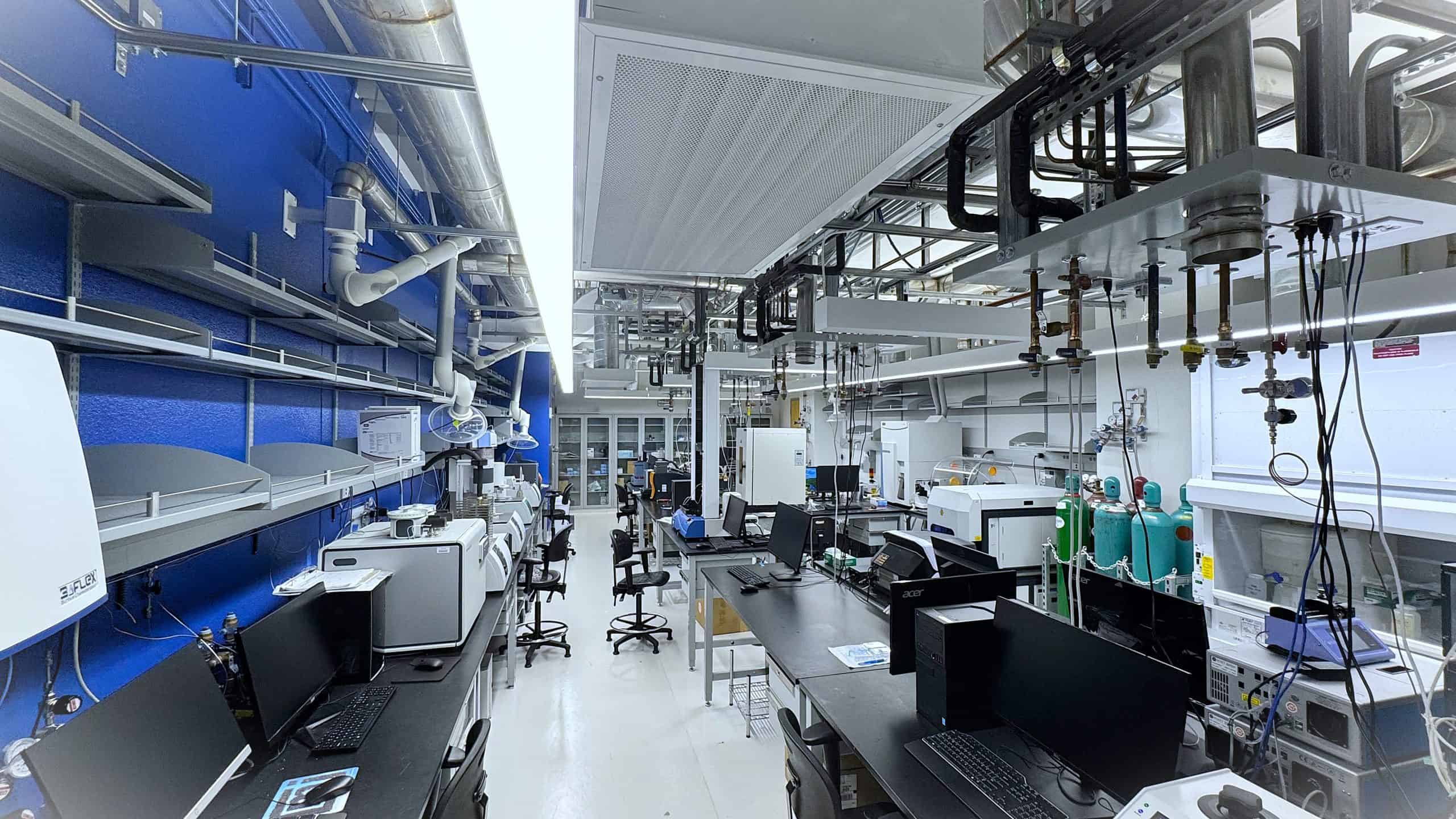
DSC2500: This thermal instrument measures materials phase transitions (e.g., ice melting) under controlled heating between -90 C and 400 C.
TG Libra: This is one of the two TG instruments, part of the thermal instrument family. It measures how materials weight changes upon controlled heating from room temperature until 1100 C.
Q500 TGA: Same function as TG Libra but is built by TA Instruments.
STA: This is the most capable thermal instrument in TEMPR Lab. It can measure phase transitions and weight changes at the same time while in-line mass spectrometry and FT-IR enable real-time analysis of gases generated during materials decomposition.
FlashSmart: Elemental analysis of C, H, N, S, and O in organic compounds, commonly in quality control in pharmaceuticals.
ICP-MS: Elemental analysis of almost all metal elements capable of measuring concentrations down to ppt. Essential tool for drinking water quality control and forensic toxicology.
easyXAFS: Using X-ray to identify chemical environments of transition metal elements. Different elements under various chemical conditions absorb X-rays across different energies.
EDX07000: Using X-ray induced fluorescence to identify and quantify metal elements within almost any materials in any form, from liquid water to a wedding ring.
Q800 DMA: This unit measures delicate solid mechanical behaviors with deformation as small as a few micros unseeable with naked eyes.
Instron: This mechanical measurement unit is capable of stretching or compress materials with up to 50,000 N of force. Current configurations are set for plastic materials with maximal force of 500 N.
3Flex: This unit can measure surface areas and pore sizes of porous solid materials with pore sizes as small as a few angstroms.
AccuPyc: This unit measures volumes of solid materials following the classic pressure-temperature-volume equation.
APC: This unit can measure particle sizes or polymer molecular weights including plastics, drug candidates, proteins, and other biomaterials.
Rheometer: This instrument measures all kinds of flow behaviors of liquid materials. It is the essential tool for monitoring the quality of cosmetics, food items, paint, and almost any other liquid products you can think of.
The newly established TEMPR Facility in mid-2019 is a world-class shared laboratory for the physical property characterization and elemental analysis of bulk and thin-film biological, soft, and hard materials. The facility houses a suite of state-of-the-art characterization instruments capable of measuring materials’ thermal, elemental, mechanical, physical, and rheological properties.
Differential scanning calorimeter provides versatile materials phase transition measurements from -90 to 400 °C. In particular, the Discovery series DSC 2500 is equipped with a new Fusion Cell™ for high sensitivity, resolution, reproducibility, and reliability. A linear autosampler allows for worry-free 24/7 operation. Modulated DSC® technology enables efficient separation of complex thermal events. Two thermogravimetric analyzers (Netzsch TG 209 F1 Libra® and TA Instruments TGA Q500) are capable of measuring materials’ mass changes at temperatures from ambient conditions up to 1100 °C with a resolution of 0.1 μg. A simultaneous thermal analyzer NETZSCH STA 449 F3 Jupiter® allows for the measurement of both mass changes and thermal effects up to 1600 °C from a single sample run. An in-line coupled system of a Bruker ALPHA II Fourier transform-infrared (FT-IR) spectroscopy and a QMS 403 D Aëolos® quadrupole mass spectrometer offers comprehensive evolved gas analysis for materials decomposition or desorption.
A combination of a TA Instruments Discovery series HR-2 hybrid rheometer, a dynamic mechanical analyzer Q800, and an Instron 3365 Universal Testing System can measure mechanical properties of soft materials, liquids, formulations, and composites by introducing force from as little as 0.0001 N up to 500 N.
A state-of-the-art Thermo Scientific™ iCAP™ RQ Inductively Coupled Plasma Mass Spectrometer offers ultra-trace elemental analysis at sub-ppb to ppt levels and provides elemental screening in minutes. The coupled laser ablation system with a 193 nm pulsed excimer laser allows for solid sample introduction and surface elemental profiling.
A Waters ACQUITY Advanced Polymer Chromatography (APC) system fractionates and characterizes polymers and nanomaterials with in-series coupled Wyatt μDAWN multi-angle light scattering (MALS) and Optilab UT-rEX refractive index (RI) detectors providing a fast and accurate determination of particle sizes and distributions, absolute molecular weights of polymers, and even 3D geometric features of synthetic or natural macromolecules across a broad range of molecular weights (3000 ~ 2,000,000 g/mol).
Within this merit review period, Dr. Xiaofeng Liu has been directing UCI’s Thermal, Elemental, Mechanical, Physical, and Rheological (TEMPR) Facility. He has been overseeing more than 20 materials characterization instruments, teaching bulk materials characterization techniques, and contributing substantially to the overall management of IMRI. Dr. Liu has earned great reviews and respect from users in this position. Dr. Liu also participated actively in research activities and public services within IMRI and across the campus.
Professional Competence and Activity
TEMPR Facility was established in July 2019 for the analysis of bulk soft and hard materials across disciplines. The facility joined MRSEC in 2020 and serves an essential role for both on-campus users and researchers from other research institutions and local industry. The facility currently houses a suite of state-of-the-art characterization instruments. The portfolio includes thermal analysis instruments (DSC2500, DSC Q2000, DSC Polyma, TGA Libra, TGA Q500, STA), chemical and elemental analysis instruments (FlashSmart, ICP-MS, easyXAFS, EDX-7000, Aelos QMS, and Bruker FT-IR, Teledyne Laser Ablation System), mechanical and rheological analysis instruments (DMA Q800, DMA 850, HR-2 rheometer, and Instron 3365), physical analysis instruments (3Flex, AccuPyc, and APC-MALS-RI, APC-PDA-RI, and UPLC), summing up to a total of 22 instruments.
One of Dr. Liu’s primary responsibilities is to oversee the day-to-day operations of many materials characterization instruments listed above, including instrument maintenance, serving the testing needs of academic and industrial users, teaching and training users on these instruments and related techniques, coordinating with service technicians and sales personnel to advance the characterization capability, employing educational activities to researchers across the board, leading the upgrade of the facilities, and promoting the facilities on and off campus.
Dr. Liu has maintained a lab with more than 20 instruments proactively to allow for maximal up time. He has equipped himself with application-level knowledge in teaching and educating all areas that are covered by the TEMPR facility. He could work independently for troubleshooting, component replacement, and repairing other issues. Meanwhile, he has kept a close relationship with all vendors for major instrument repairs and led the effort of upgrading the instruments.
Dr. Liu had provided timely instrument training sessions to users since the lab was established. TEMPR has received growing numbers of training requests each fiscal year: 259 (2021-2022), 283 (2022-2023), and 297 (2023-2024), which were submitted by 119, 144, and 125 unique users, respectively. The total number of unique users between 2021 and 2024 is 309. During these same fiscal-year periods, the total hours of instrument usage in TEMPR Lab are: 6115 hours (2021-2022), 7144 hours (2022-2023), and 8613 hours (2023-2024). The corresponding recharge incomes are: $68k (2021-2022), $75k (2022-2023), and $131k (2023-2024).
Led the acquisition, installation, teaching, and maintenance of UPLC, and APC-PDA-RI under the MRSEC program between 2020 and 2024. Dr. Liu has also:
Led the installation and maintenance of easyXAFS since September 2022.
Led the acquisition and installation of DMA 850 in 2024 under the MRSEC program.
Led the installation and maintenance of EDX-7000 in 2023 from a donation of Shimadzu.
Led the upgrade efforts for Instron 3365 UTS, APC, and HR-2 rheometer in late 2024.
Dr. Liu took UCI compliance training courses and maintained an up-to-date portfolio of chemical and instrumental inventories and safety-compliant documents and lab practices.
Dr. Liu recruited three lab specialists working in assisting users with characterization needs as well as the day-to-day operations of the lab. These lab specialists contributed to user engagement, project services, problem-solving, instrument maintenance, lab maintenance, and marketing.
Dr. Liu made great efforts in attracting external users and providing them with testing services. Staff-run project services have been completed timely to deliver high-quality testing results and technical reports to users on- and off-campus including research institutions and companies.
Research and Creative Work
Dr. Liu has been participating in discussing project ideas and developing research collaboration opportunities with research groups in the Schools of Engineering, Physical Sciences, and Medicine as well as startup companies and external institutions. Dr. Liu created promotional material to expand the users reach of TEMPR facility and educate users about TEMPR’s capabilities inside and outside of UCI. TEMPR facility has supported many publications in peer-reviewed journals. A selected list of publications can be seen at the appendix:12 in 2021-2022, 15 in 2022-2023, and 21 in 2023-2024.
Dr. Liu has maintained an active research profile in line with his primary duty of overseeing the facilities. He collaborated with UCI and external researchers on ten projects. He co-first authored a research paper published in Nanophotonics (DOI: https://doi.org/10.1515/nanoph-2020-0214) during the time in TEMPR.
He was a supporting person for the proposal “Fast, free-breathing, arrhythmias-insensitive, cardiac Quantitative Susceptibility Mapping (QSM) for accurate intramyocardial assessment in iron-targeted intramyocardial hemorrhagic therapy” led by Cedars Sinai Medical Center and UCLA.
He provided five supporting letters for five SBIR proposals led by Ecotune.
He provided a supporting letter for a project by Intelligent Optical Systems.
He was a supporting person for one SBIR proposal by Versatiled.
He served as consultant and co-participant for a grant titled “Ex Vivo Assessment of Muscle Fixation Techniques” led by researchers in the UCI medical school.
He participated in the IMRI open house in 2022 and 2023.
He participated in the MRSEC five-year review by NSF in 2024.
He gave IMRI facility tours to visitors on- and off-campus.
University and Public Service
In addition to his job duties, Dr. Liu has been promoting the usage of new tools and software (e.g., Teams) for communication across the team and beyond to improve work and collaboration efficiency.
Dr. Liu has also been actively involved in event organization for IMRI and CCAM. He has been part of the coordination committee for organizing the annual ISAMS and STEM school. He is also the organizing committee member of the upcoming 16th International Symposium on Ferroic Domains & Micro- to Nano-scopic Structures (ISFD-16). He has designed and maintained all relevant websites and registration workflows for these events.
Dr. Liu served as a contributor for the IMRI and CCAM newsletters.
Dr. Liu led the kickstart of the Marketing Initiatives to promote IMRI and MRSEC in 2024 which includes the hiring of undergraduate marketing assistants, planning online content marketing, and conceptualizing online webinars and lectures.
Dr. Liu started his position as TEMPR Facility Manager on March 15th, 2019, to lead the initiative to set up the cross-disciplinary and collaborative materials characterization laboratory with capabilities of measuring thermal, elemental, mechanical, physical, and rheological (TEMPR) properties of materials in a diverse variety of research and application fields. Dr. Liu advises and collaborates in academic and industrial projects. His areas of research interests include organic materials and semiconductors, functional composite materials, and flexible integrated electronics.
TEMPR Facility was established in July 2019, and it is a world-class shared core facility for the analysis of bulk soft and hard materials across disciplines. The facility serves both on-campus users and researchers from other research institutions and local industry. The facility currently houses a suite of state-of-the-art characterization instruments. The portfolio includes thermal analysis instruments (DSC 2500, DSC Q2000, DSC Polyma, TGA Libra, TGA Q500, STA-QMS-FTIR), elemental analysis instruments (CHNS/O, LA-ICP-MS), mechanical analysis instrument (DMA Q800 and Instron 3365), physical analysis instruments (3Flex, AccuPyc, and APC-MALS-RI), and a rheological analysis instrument (DHR-2), summing up to a total of 14 instruments.
Since TEMPR’s opening in mid-2019, Dr. Liu has been the core contact in operating and management of the TEMPR facility, serving all users with timely response and thorough tutorials of each aspect of technical questions. Dr. Liu has earned great reviews and respects from users during the past two and a half years in this position. On top of his job duties in helping everyone in need around the lab, Dr. Liu participated actively in research activities and public services within IMRI and across the campus.
Research and Creative Work
The job duties as a lab manager switch the focus of active research projects and ideas to smoothly maintaining lab operations and assisting users with all kinds of research needs. Dr. Liu has adapted to his new role very quickly thanks to his experience as a lab manager in UC Santa Barbara as well as management role during his time in two separate startup companies. Dr. Liu has been participating in discussing project ideas and to develop research collaboration opportunities with research groups in the Schools of Engineering, Physical Sciences, Pharmaceutical Sciences, and Medicine. As an example, Dr. Liu proposed the use of ICP-MS technique to a number of biomedical research projects from the School of Medicine, including studies of platinum uptake in cancer cells and residual metals analysis in e-cigarettes. Dr. Liu provided one letter of support to an NIH grant application from the School of Medicine and three letters of support to small business grant applications from SBIR, EPA, and USDA. One of the small business grants from EPA was awarded in 2022. Dr. Liu had offered three in-person presentations to research groups within the Schools of Engineering and Physical Sciences and three virtual presentation and discussions to research group in the School of Medicine, CSU Long Beach, and UC Riverside. Dr. Liu also created slides material in order to promote TEMPR facility and educate potential users about TEMPR’s capabilities and distributed it to many research groups inside and outside of UCI. Dr. Liu also forged close collaboration with the Center for Isotope Tracers in Earth Science (CITIE) within the School of Physical Sciences led by Prof. Kathleen Johnson in providing analysis service and serve the local research community.
Dr. Liu organized three onsite training courses and instrument demonstrations including (1) a two-day 3Flex onsite training course with Micromeritics (09/04/2019-09/05/2019) with 6 participants from the Schools of Engineering and Physical Sciences; (2) a nano-indenter demonstration with Optics11 on 01/17/2020 with more than 20 participants; (3) a two-day ICP-MS onsite training course with ThermoFisher Scientific (02/11/2020-02/12/2020) with 30 participants from UCI Schools of Engineering, Physical Sciences, and Medicine. In addition to running the TEMPR Facility and serving users, Dr. Liu forged research collaborations with groups at UCLA and Jilin University. The recent results are published in Nanophotonics (DOI: https://doi.org/10.1515/nanoph-2020-0214) with Dr. Liu serving as co-first author.
Professional Competency and Activity
Shortly after the opening of TEMPR facility to the public, Dr. Liu designed and implemented a new training request sign-up system, streamlined the sign-up process with a much more friendly user interface, and received wide acceptance and acknowledgement from users. this largely lowered the burden from new users in getting access to the facility for their benefit. Dr. Liu has also employed Google Drive system to standardize data management as well as data sharing across TEMPR Facility which provides users with cloud access to knowledge base, standard operating procedures, and other relevant references for each instrument. Since most techniques in TEMPR facility require substantial knowledgebase to understand or even operate the instruments, Dr. Liu has been maintaining an active database of technical documents and presentations related to the thermal, elemental, mechanical, physical, and rheological properties of materials, which are either originally created or secured through personal contacts with technology companies and individuals.
Dr. Liu recruited four student lab assistants – three current UCI graduate students and one postdoctoral researcher from the Schools of Engineering and Physical Sciences – to assist users with thermal, elemental, mechanical, and physical property characterization, respectively. These four lab assistants contribute to user engagement, project services, problem-solving, and instrument maintenance.
TEMPR has been operated for two years during the review periods plus a half year in 2021. During the first year of operation, 92 unique users from UCI, other universities, and industry have been trained to use one or more TEMPR instruments. In addition, Dr. Liu has coordinated staff-run experiments for 20 researchers with the lab assistants with 13 researchers not trained on TEMPR instruments which makes the total number of users who made use of TEMPR is 105. The second year, TEMPR added 41 additional unique users and 16 return users. Staff-run projects were performed for 19 researchers in which 14 are not trained which makes the total number of people who made use of TEMPR in its second year is 71. the total number of users added per year per instrument is detailed in Table 1.
The first year of operating TEMPR has achieved a total of 4510 hours of instrument use and $47,532.5 in recharge income, while user-run experiments account for 4,351.5 among these hours and 77.2% of the income. TEMPR had a total of 7,404 hours of instrument use and $84,329 in recharge income in its second year of operation, a 64% increase in usage hours and a 77% increase in recharge income, respectively, compared to year 1. User-run experiments accounted for 6,829 of these hours and 74.7% of the income during year 2.
Table 1. Number of New Users added Per Year Per Instrument
Number of New Users
Instrument
07/2019-06/2020 (Year 1)
07/2020-06/2021 (Year 2)
07/2021-01/2022 (7 months)
DSC 2500
14
9
7
DSC Q2000
8
2
1
DSC Polyma
8
0
2
TGA Libra
11
6
3
TGA Q500
11
4
2
STA-QMS-FTIR
35
6
7
FlashSmart
6
3
4
ICP-MS
18
16
4
LA-ICP-MS
0
12
2
DMA Q800
24
8
13
Instron
6
8
8
APC-MALS-RI
16
3
6
3Flex
16
11
5
DHR-2 Rheometer
15
10
9
AccuPyc
5
0
2
Staff-run project service is a central effort in attracting potential users from local research institutions and companies. In sum, 27 projects in year 1 (2 projects done by two lab assistants), 49 projects in year 2 (5 projects done by one lab assistant), and 32 projects for the 6 months in year 3 were carried out in a timely manner coordinated by Dr. Liu and lab assistants. These staff-run experiments accounted for the 158.5 hours and 22.8% of the income during the first year, while 575 hours and 25.3% of the income were recorded for year 2, an increase of over 260% in staff hours and over 95% in recharge income as compared with year 1.
In particular, usage hours and recharge incomes for the major instruments in TEMPR are summarized below. During the first year of operation, STA-QMS-FTIR recorded 1,936.5 hours (42.9% of total TEMPR usage hours), representing $17,535 in recharge income (36.9% of total income). The second, third, fourth, and fifth most used instruments are the 3Flex (658.5 hours, 14.6% of total TEMPR usage hours; $3,925, 8.3% of total income), the Q800 DMA (539.5 hours, 12% of total usage hours; $4,695.5, 9.9% of total income), the DSC 2500 (314 hours, 7.0% of total usage hours; $2,685, 5.6% of total income), the ICP-MS (217.5 hours, 4.8% of total usage hours; $4576.5, 9.6% of total income) respectively. The other nine instruments represent a combined 18.7% of total usage hours and 29.7% of total income. Going into the second year, STA-QMS-FTIR was used for 2,933 hours (39.6% of total TEMPR usage hours), representing $28,893 in recharge income (34.3% of total income). The second, third, fourth, fifth, sixth most used instruments are the 3Flex (1,638 hours, 22.1% of total TEMPR usage hours; $12,574, 14.9% of total income), the ICP-MS (602 hours, 8.1% of total usage hours; $19,616, 23.3% of total income), the Q800 DMA (588 hours, 7.9% of total usage hours; $3,839, 4.6% of total income), the DSC 2500 (413 hours, 5.6% of total usage hours; $6,210, 7.4% of total income) and TGA Libra (413 hours, 5.6% of total usage hours; $2,864, 3.4% of total income), respectively. The other eight instruments represent a combined 11.1% of total usage hours and 12.1% of total income.
With comparison between year 2 and year 1 during the short time period of TEMPR operations, it is foreseeable that the future perspective is rapidly ramping up, especially based on the fact that TEMPR offers unique technical aspects across a large geographical area with professional staff support.
University and Public Service
In addition to his job duties, Dr. Liu has been researching on competitive facilities management systems with the aim of improving working efficiency as well as expanding management capacity from the existing system. Dr. Liu has also been actively involved in event organization for IMRI. He has been part of the coordination committee for organizing ISAMS-2, ISAMS-3, and ISAMS-4 on a yearly basis. Dr. Liu designed and deployed the entire IMRI (http://imri.uci.edu) and MRSEC (http://ccam.uci.edu) websites from scratch during the COVID period and is served as the main contact in maintaining and improving the websites.